
- Solutions
-
- Products
-
Search BY CategorySearch BY Product
RFID Asset Tracking in 2026: Challenges, Latest Trends and the Future of Smart Asset Management
Posted by Neeraj Purbia November 11, 2026, 11:43 am
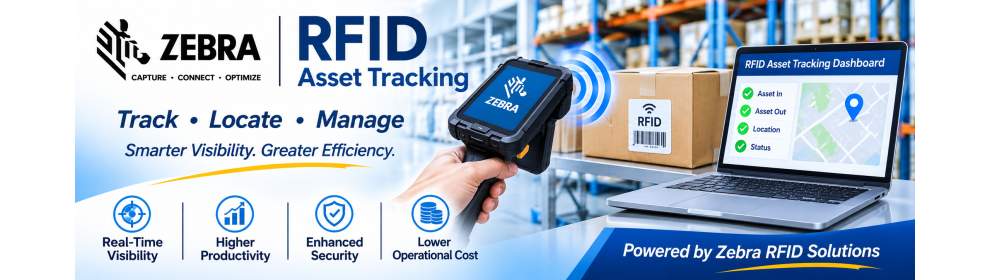
How RFID, IoT, AI and Real-Time Asset Visibility Are Transforming Modern Businesses
Introduction
Managing thousands of physical assets across warehouses, factories, hospitals, offices and distribution centres is becoming increasingly challenging.
Businesses need to know:
Where is each asset located?
Who is currently using it?
Has it been transferred to another department?
Is equipment missing, misplaced or underutilised?
When does an asset require maintenance?
How can we reduce manual inventory checking and operational costs?
Traditional asset-management methods based on spreadsheets, manual registers and barcode scanning are often insufficient for modern business requirements.
This is where RFID (Radio Frequency Identification) asset tracking is transforming the way organisations identify, monitor and manage their physical assets.
In 2026, RFID is evolving beyond simple identification. Its integration with Artificial Intelligence (AI), Internet of Things (IoT), cloud platforms, Bluetooth Low Energy (BLE) and Real-Time Location Systems (RTLS) is creating a new generation of intelligent asset-management solutions.
1. What Is RFID Asset Tracking?
RFID asset tracking is a technology that uses radio-frequency tags and readers to automatically identify and monitor physical assets.
Unlike traditional barcode systems, RFID does not require direct line-of-sight scanning. Multiple RFID tags can be detected simultaneously, making inventory audits and asset verification significantly faster.
A typical RFID asset-tracking solution consists of:
RFID Tags
Passive UHF RFID labels and hard tags.
On-metal RFID tags for machinery and equipment.
Durable tags for reusable containers and industrial assets.
RFID Readers
Handheld RFID readers.
Fixed RFID readers.
Integrated RFID readers.
RFID antennas and access-point infrastructure.
Software and Middleware
Asset registration and identification.
Location and movement records.
Automated inventory audits.
Asset assignment and transfer management.
Alerts and reporting.
ERP and warehouse-management integration.
The combination of these technologies provides better asset visibility, accountability and operational efficiency.
2. Major Challenges in Traditional Asset Management
Many organisations still face common problems when managing their assets.
Employees spend significant time physically checking equipment, computers, tools, machinery and other assets.
Manual checking:
Consumes employee working hours.
Increases the possibility of human errors.
Makes large-scale audits difficult.
Creates outdated asset records.
Equipment frequently moves between departments, warehouses, branches and employees without proper documentation.
Without automated tracking, organisations may purchase additional equipment even when existing assets are available but misplaced.
Traditional barcode systems generally require an employee to scan each asset individually.
Businesses cannot automatically identify every movement without a defined scanning process.
High-value equipment, laptops, tools, medical devices and machinery may leave designated locations without proper approval.
Without movement monitoring, identifying unauthorised transfers can become difficult.
Businesses often struggle to identify:
Equipment that is not being used.
Assets requiring preventive maintenance.
Equipment approaching its replacement date.
Assets that are assigned but unavailable.
RFID combined with asset-management software can help address these challenges.
3. Latest RFID Asset Tracking Trends in 2026
The RFID industry is moving towards intelligent, connected and automated asset management.
Here are some important developments businesses should consider.
AI is making RFID data more valuable.
Traditional RFID systems identify tagged assets. AI-enabled platforms can analyse asset movement patterns and identify unusual activities.
Examples:
Identify unusual asset movements.
Detect unexpected equipment transfers.
Predict maintenance requirements when combined with sensor and maintenance data.
Analyse asset utilisation.
Identify inventory discrepancies.
Generate operational reports automatically.
The future of RFID is not simply identifying assets but understanding how efficiently they are being used.
IoT integration allows organisations to connect RFID identification with environmental and operational sensors.
For example:
Temperature monitoring.
Humidity monitoring.
Equipment condition monitoring.
Cold-chain monitoring.
Movement and utilisation monitoring.
This is particularly useful in pharmaceuticals, healthcare, food processing, manufacturing and logistics.
Businesses increasingly want to know not only whether an asset has been detected but also where it is located.
Different technologies serve different requirements:
UHF RFID: Automatic identification and zone-based visibility.
BLE: Wireless asset monitoring and location estimation.
UWB: High-precision indoor location tracking.
Active RFID: Longer-range tracking using battery-powered tags.
The selection depends on required location accuracy, infrastructure, asset value and operating environment.
Cloud-based systems allow businesses to manage assets across multiple offices, warehouses and geographical locations.
Advantages include:
Centralised asset database.
Access from multiple locations.
Real-time movement records.
Automated inventory reports.
User-level permissions.
Maintenance scheduling.
Integration with ERP systems.
Cloud platforms also reduce the need for businesses to maintain complex local infrastructure.
Mobile RFID technology is becoming increasingly important.
Employees can use handheld RFID readers to conduct asset audits, verify equipment and locate missing items.
Zebra handheld RFID solutions offer businesses flexible options for warehouse, retail, healthcare and industrial applications.
Manufacturers are increasingly developing smaller, thinner and more economical RFID inlays.
Reusable tags, recyclable materials and improved tag designs are helping businesses consider RFID for a wider range of assets and products.
4. Major Challenges When Implementing RFID Asset Tracking
Although RFID offers substantial benefits, successful implementation requires proper planning.
Metal can reflect and interfere with radio-frequency signals.
Standard RFID labels may not perform reliably when directly attached to metal machinery, computers, tools or industrial equipment.
Solution: Select specialised on-metal RFID tags designed for metallic surfaces.
Liquids can absorb RF energy and reduce RFID performance.
This is particularly important in food processing, pharmaceutical and chemical environments.
Solution: Use appropriate RFID tag designs and test the installation under actual operating conditions.
Incorrect reader and antenna placement can create:
Missed tag readings.
Unwanted reads from adjacent areas.
Inconsistent read performance.
Unreliable movement records.
Solution: Conduct an RFID site survey and optimise antenna positioning, power levels and read zones.
RFID hardware alone cannot provide a complete asset-management solution.
Businesses need software that connects RFID data with their existing ERP, inventory and maintenance systems.
Solution: Use RFID middleware and APIs to integrate the hardware with enterprise applications.
The cost of tags, readers, antennas, installation, software and employee training must be considered.
Solution: Begin with a pilot project in one department or warehouse, measure the results and expand gradually.
5. Zebra RFID Solutions: Enterprise-Ready Asset Visibility
Zebra Technologies is a recognised provider of enterprise RFID hardware and mobile computing solutions.
Its RFID portfolio includes:
Handheld RFID Readers
Suitable for:
Asset audits.
Warehouse inventory.
Equipment verification.
Mobile asset tracking.
Fixed RFID Readers
Suitable for:
Warehouse entry and exit points.
Automated asset movement monitoring.
Production lines.
Distribution centres.
RFID Antennas
Designed to support different read zones and operating environments.
RFID Printers and Labels
Used to create RFID-enabled identification labels for assets, products, cartons and other applications.
Zebra RFID solutions support applications across manufacturing, healthcare, retail, transportation, logistics and government.
Official product information:
https://www.zebra.com/us/en/products/rfid.html
6. RFID Asset Tracking Applications Across Industries
Medical equipment tracking.
Wheelchair and stretcher management.
Surgical instrument tracking.
Medical device inventory.
IT equipment management.
Machinery and tool tracking.
Work-in-progress monitoring.
Production equipment management.
Reusable container tracking.
Industrial asset audits.
Pallet and container tracking.
Inventory verification.
Dock-door monitoring.
Shipment identification.
Returnable transport item management.
Laptop and desktop tracking.
Printer and computer inventory.
IT equipment assignment.
Employee asset accountability.
Office equipment audits.
Tool tracking.
Equipment monitoring.
Machinery allocation.
Site-to-site asset transfers.
High-value equipment management.
7. How to Successfully Implement an RFID Asset Tracking System
A successful project should follow a structured implementation process.
Step 1: Identify Your Assets
Prepare a complete list of equipment, machinery, tools, computers and other assets.
Step 2: Select Appropriate RFID Tags
Consider asset material, size, environment, durability and reading distance.
Step 3: Choose RFID Readers
Determine whether your application requires handheld readers, fixed readers or a combination.
Step 4: Conduct a Site Survey
Evaluate the environment, metal interference, read zones, antenna positioning and network infrastructure.
Step 5: Implement Asset Management Software
Connect RFID hardware with a central asset database.
Step 6: Integrate with ERP
Connect asset information with procurement, finance, inventory and maintenance modules.
Step 7: Conduct a Pilot Project
Test the system in a representative operational area before implementing it across the organisation.
Step 8: Measure Performance
Evaluate inventory accuracy, audit time, missing assets, equipment utilisation and overall return on investment.
8. The Future: Intelligent and Automated Asset Management
The next generation of asset management will combine multiple technologies rather than depend on RFID alone.
The convergence of RFID, BLE, UWB, IoT, AI and cloud computing will help businesses build intelligent asset ecosystems.
Instead of relying on employees to manually locate and verify equipment, organisations will increasingly use automated identification, movement events, analytics and alerts.
The objective is simple: The right asset, at the right location, available at the right time.
Conclusion
RFID asset tracking is no longer just an inventory-management technology. It is becoming an essential part of digital transformation.
Businesses that invest in the right combination of RFID hardware, software and enterprise integration can improve operational visibility, reduce asset losses, save employee time and make better utilisation decisions.
However, choosing the right tags, readers, antennas and software is essential to achieving reliable results.
With the right technology partner, RFID can become a long-term investment in business efficiency and operational control.
Why Choose Pegasus International for RFID and Asset Tracking Solutions?
Pegasus International provides technology solutions for businesses looking to modernise their asset identification, tracking and management processes.
Our solutions combine RFID technology, barcode identification, mobile computing and asset-management software.
Our solution portfolio includes:
Zebra RFID handheld readers.
Fixed RFID readers and antennas.
RFID printers and labels.
Barcode printers and scanners.
Mobile computers and rugged tablets.
RFID and barcode asset-management software.
Enterprise integration and customised solutions.
Whether you manage a warehouse, hospital, manufacturing facility, logistics operation or corporate IT department, Pegasus can help you plan and implement an appropriate asset-tracking solution.
Contact Pegasus International
Website: https://www.PegasusTech.net
RFID Solutions: https://www.pegasustech.net/RFID-Asset-management
A. Manual Inventory Management
B. Lost and Misplaced Assets
C. Lack of Real-Time Visibility
D. Asset Theft and Unauthorised Movement
E. Maintenance and Asset Utilisation
Trend 1: RFID + Artificial Intelligence (AI)
Trend 2: RFID + Internet of Things (IoT)
Trend 3: Real-Time Location Systems (RTLS)
Trend 4: RFID + Cloud-Based Asset Management
Trend 5: Mobile RFID and Handheld Readers
Trend 6: Sustainable and Cost-Effective RFID Tags
Challenge 1: Metal Surfaces
Challenge 2: Water and Liquid Interference
Challenge 3: Reader and Antenna Placement
Challenge 4: Integration with Existing ERP Systems
Challenge 5: Initial Investment and ROI
Healthcare and Hospitals
Manufacturing
Warehousing and Logistics
Corporate Offices and IT Departments
Construction and Infrastructure
- Products
-
 Assets Management
 Hospital Bracelet and Patient ID Barcode Wristbands
 Invoice Receipt Solution
 Personal ID Access Control
 Queue System
 Security
 Banking - ID card solution, Attendance system
 Government
 Healthcare - ID card , Attendance, Hospital system
 Retail - ERP|POS | E-commerce | Warehousing solution
 Telecommunication Barcoding , Packing and Attendance System
 Pryce – The Cloud ERP System (Prj-123)
 Phomello TriggerPOS : POS System Android APP (Prj-122)
 TimeMan : Enterprise Cloud Time Attendance System (Prj-146)
 Face Recognition Mobile Attendance system - SuperTime (Prj-149)
 Mobile Computer
 Barcode Scanner
 Data Collector
 Barcode Printers
 Mobile Printers
 Rugged Tablet PC
 Retail & Restaurant POS System series
 Price Checker
 POS Printers
 POS Accessories
 ID Card Printer
 Biometrics Attendance System | Finger Attendance System | Face Attendance system
 Free Standing Kiosk
 Android Application
 iPhone Application
 Mobile Apps Development
 Offshore development Center
 Product Outsource Development
 Content Management
 Custom Software Development
 Customize Web Based ERP
 Smart Card
 Web Portals